Interview field guide
System Design Interview: A Beginner's Playbook
No whiteboard heroics required. Here is the framework senior engineers use to stay structured for 45 minutes, the questions to ask first, and the practice routine that makes it stick.
The short answer
System design interviews do not reward memorized architectures. They reward a repeatable process: clarify the problem, estimate the load, sketch a simple design, then improve it while talking through trade-offs. Practice the process on paper, out loud, until it is boring.
What the round actually tests
In a system design round you get a vague prompt — "design Instagram", "build a URL shortener" — and 40 to 50 minutes to turn it into a working architecture. The interviewer is not checking whether you have seen the exact answer before. They are evaluating four things:
- Requirements thinking. Can you turn a vague prompt into concrete questions about users, scale and constraints before designing anything?
- Trade-off reasoning. Every choice (SQL vs NoSQL, cache, queue) has a cost. Can you name it and justify it for this problem?
- Communication. Do you explain while you draw, invite feedback and adapt when the interviewer adds a constraint?
- Depth on demand. When they probe one part — "what happens when the cache is cold?" — can you go one level deeper?
A quiet, confident structure beats an impressive diagram with no reasoning. Interviewers read your process, not your picture.
A five-step framework
1. Clarify functional requirements (5 min)
Ask two or three sharp questions instead of listing everything. For a Twitter-like feed: "Do users see everyone's posts, or only people they follow?" "Do we need likes and comments in v1?" State explicitly what you are leaving out. Scope discipline is a scored signal.
2. Estimate the load (5 min)
Pick a scale and do rough math out loud: 100M daily active users, each reading 20 posts → 2B reads/day ≈ 25K reads/second. Write-heavy systems need different storage from read-heavy ones. The numbers you produce drive your later choices, so keep them visible on the board.
3. Define the API and data model (5 min)
Agree on a few endpoints (e.g. POST /posts, GET /feed) and sketch the core tables: users, posts, follows. Choosing a database comes after this step, not before — the access patterns decide whether a relational store, a document store or a key-value cache fits.
4. Sketch the high-level design (10–15 min)
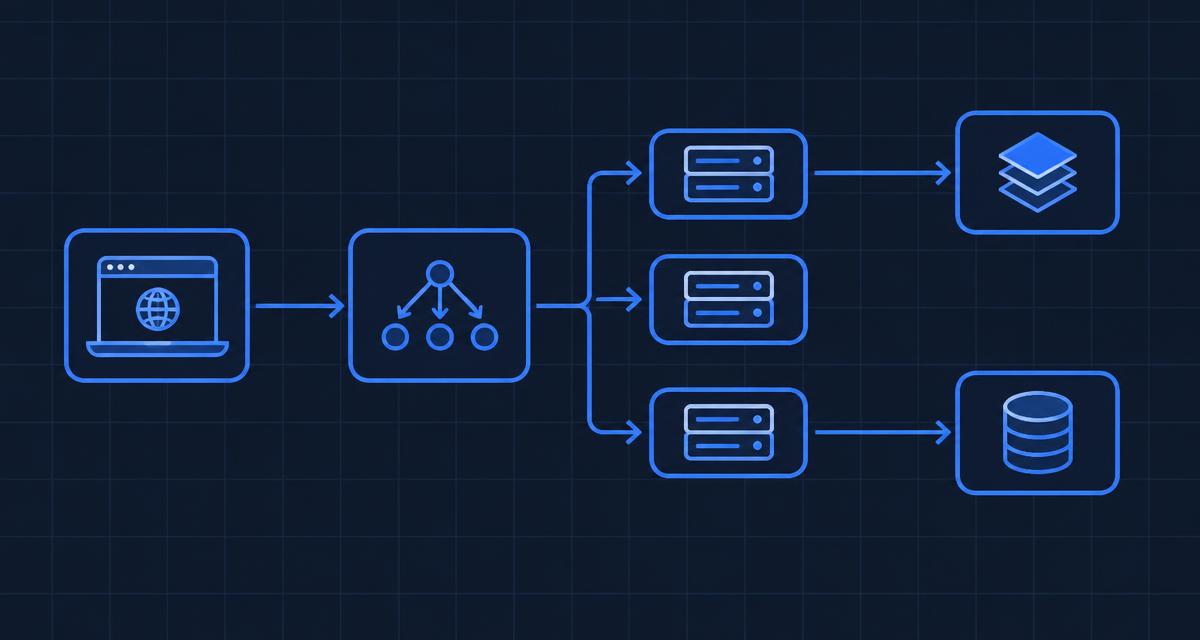
Draw client → load balancer → app servers → database, then add only what the requirements demand: a cache, a queue, a blob store for media. Keep it simple. A boring architecture you can defend beats a clever one you cannot.
5. Deep dive on the hardest part (10–15 min)
Ask the interviewer which part to explore, or pick the one with real tension — feed generation, notification fan-out, consistent counts. This is where the interview is actually won.
Making the design scale
When the interviewer says "now imagine 10× traffic", you do not redesign — you apply a small set of well-understood tools:
- Caching. Cache hot reads (Redis or Memcached) with a sensible eviction policy and a stated TTL. Know the failure mode: a cold cache after restart, a thundering herd that follows it.
- Horizontal scaling. Stateless app servers behind a load balancer scale by adding machines. Store session state outside the server, in a shared store or the client.
- Database scaling. Read replicas for read-heavy traffic; sharding for write-heavy traffic. Name the pain you accept: cross-shard queries and operational complexity.
- Queues. Push slow or spiky work (sending emails, generating thumbnails, fan-out) into a queue so the request path stays fast. Queues also absorb traffic spikes.
- CDNs and blob storage. Images and video never live in your database. Serve them from object storage through a CDN.
One more habit that separates senior answers: say what breaks. "If this queue consumer dies, posts pile up until it recovers — I'd monitor queue depth and alert at a threshold." Failure-mode awareness reads as real experience.
Worked example: a URL shortener
This is the classic starter prompt, and a full run-through of the framework takes about 25 minutes.
Requirements: shorten a long URL, redirect anyone who visits the short link, links live for years. Analytics (click counts) is nice-to-have. Estimate: 100M new URLs/month ≈ 40 writes/second; reads are 100× writes, so redirect traffic dominates — cache hot redirects.
Data model: a single table mapping short code → long URL. Generate the code with base62 encoding of an ID from a counter service (7 characters covers trillions of URLs). Discuss the alternative — hashing the URL — and its collision problem, then justify your pick.
Design: stateless app servers behind a load balancer; Redis in front of a relational database for the mapping; a 301 vs 302 redirect discussion (permanent saves load, temporary keeps analytics). For deep-dives: how the counter service avoids being a single point of failure (range allocation per server), and how to handle a hot link (cache it aggressively; if one URL gets celebrity traffic, a CDN-level edge cache helps).
That is the whole shape of a good answer: modest components, each justified by a number you estimated.
Common mistakes (and easy fixes)
- Designing before asking. Jumping straight to boxes and arrows signals a solution-first mindset. Fix: your first two minutes are questions.
- Name-dropping without trade-offs. "We'll use Kafka" means nothing until you say why a queue is needed here and what it costs. Fix: every component gets a justification sentence.
- Over-engineering. Microservices, five data stores and a machine-learning ranker for a 1M-user product bury the signal. Fix: start simple, upgrade one component when the interviewer raises the load.
- Silence while drawing. The interviewer cannot score a quiet diagram. Fix: narrate every line: "I'm putting a cache here because reads dominate."
- Ignoring the deep dive. Treating the last 15 minutes as wrap-up time wastes the highest-scoring segment. Fix: budget it deliberately.
How to practice
System design rewards reps more than reading. A simple routine:
- One design per day. Pick a prompt, set a 40-minute timer, draw and narrate out loud — even alone. The narration is the skill.
- Rotate domains. Feed systems, chat, ride-sharing, rate limiters, search autocomplete. Each teaches a different pattern (fan-out, consistency, geospatial, counting).
- Read one reference deeply. The System Design Primer on GitHub covers the vocabulary; use it to fill gaps your practice surfaces, not as a substitute for drawing.
- Debrief against real architectures. Engineering blogs like the AWS Builders' Library show how production systems actually evolved — including the mistakes, which is exactly the texture interviews reward.
After two weeks of daily reps, the framework stops feeling like a script and starts feeling like how you think.
Continue interview preparationCommon questions about the system design round
Do new grads get system design interviews?
Increasingly yes, though expectations are lower than for senior hires. Interviewers look for structure and reasonable trade-offs, not production battle scars. Practicing the five-step framework covers most of the gap.
Should I design for 10 users or 10 million?
Ask. The interviewer usually has a scale in mind, and clarifying it — instead of assuming — is itself a positive signal. When they say "you decide", pick a scale, state it, and let it drive your estimates.
SQL or NoSQL — which answer is safe?
Neither, in isolation. Name your access patterns first. Relational stores are a sensible default for most designs; document or key-value stores earn their place with specific scale or schema-flexibility needs. The reasoning is the answer, not the product name.
What if I get stuck?
Say what you are unsure about and reason through it out loud: "I think fan-out on write helps reads here, but it complicates celebrity accounts — let me think through the trade-off." Interviewers score visible reasoning far higher than silent struggle or a bluff.